
Plants
ReactTypeScriptRadix UICloudflare WorkersCloudflare D1Claude
Overview
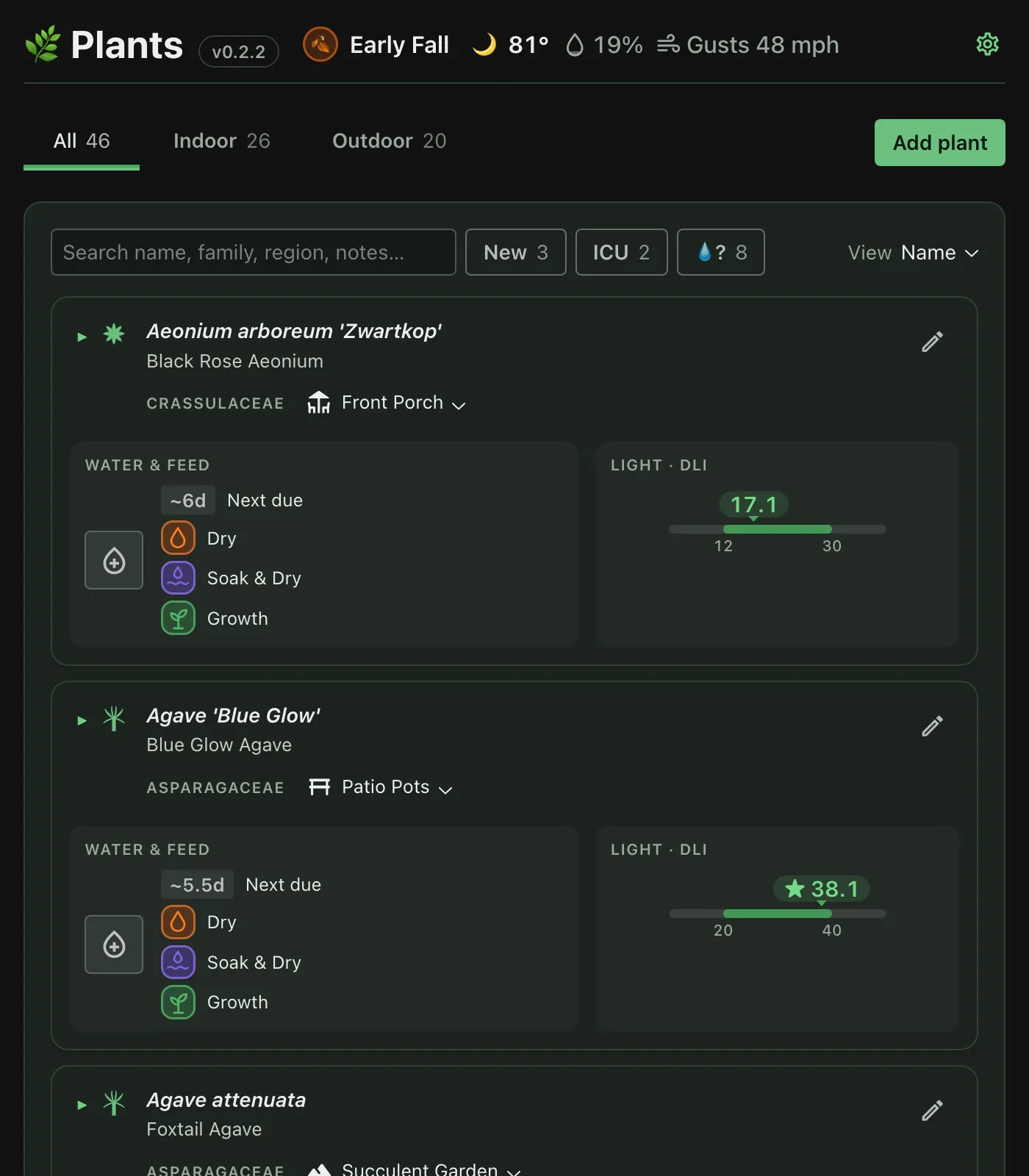
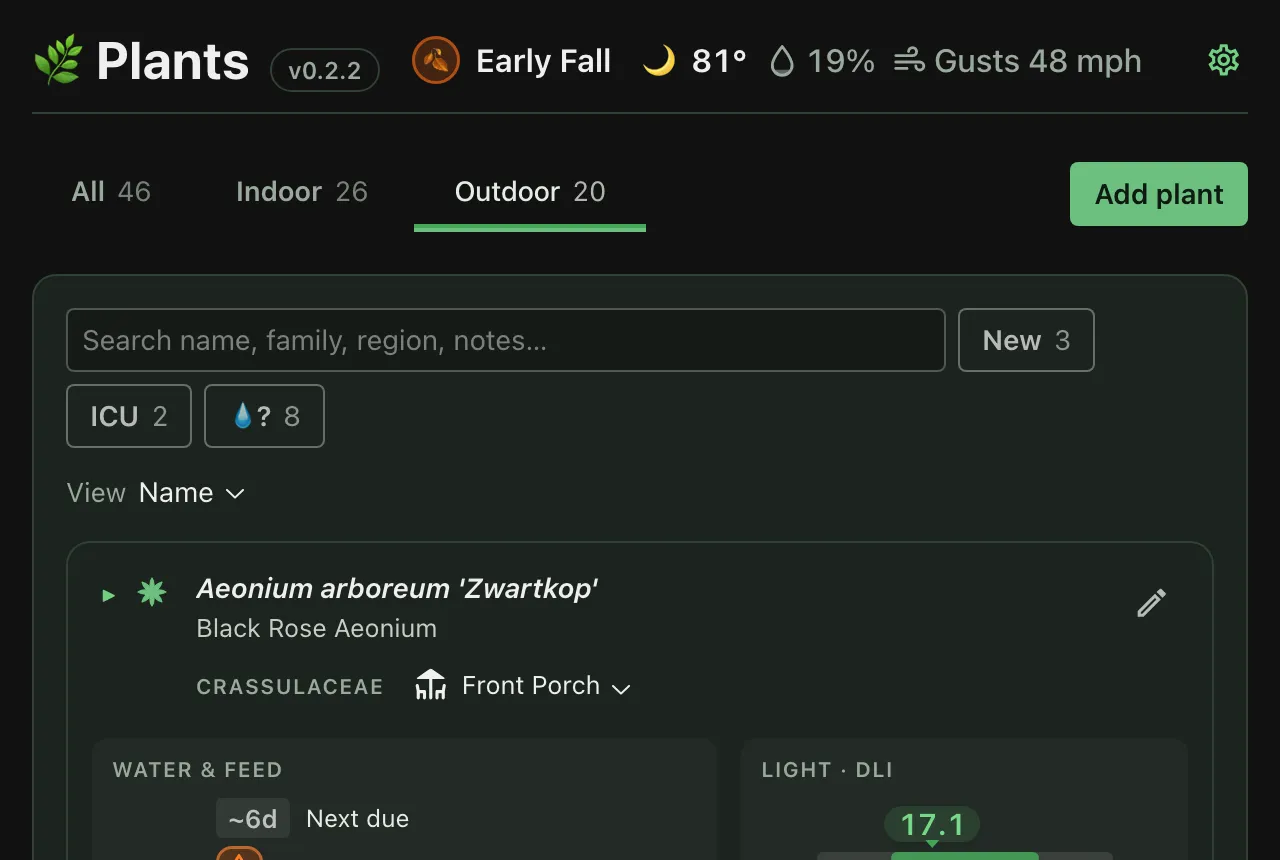
Plants is how I keep track of my collection.
Each plant has a care group, a location, a substrate, and a watering trigger, and the app works out from those what it needs right now: whether it's growing or resting this season, when to water it, what to feed it, and whether its spot gets enough light.
The live demo is the real interface running on a made-up collection in your browser, with houseplants indoors and succulents and cacti outside for a grower in Thousand Oaks, California. Changes reset when you reload. The weather is live; the Claude features run on my own computer, so the demo leaves them out.
What It Does
- Knows the season: six seasons that follow the local climate, each with measured night lows, day highs, and rain. A care group grows or rests by a Rest Trigger, thresholds on those values or on day length, so a plant's care changes as the weather does.
- Plans care per plant: watering trigger and technique, this season's feed with its recipe, and a watering estimate from the pot, the substrate mix, and the waterings I've logged.
- Checks the light: each location has its light, hours, and microclimate, and every plant shows its daily light integral against the range it wants, for grow lights and for sun through a window.
- Watches the weather: live conditions in the header and a forecast for the outdoor plants, with alerts when a cold night or a hard rain is coming for one that can't take it, and hardiness shown as an RHS rating and USDA zone.
- Keeps the reference: care groups, feeding formulas, substrate mixes, seasons, and microclimates are all records I can edit in place, and a change to a care group updates every plant in it.
- Adds plants quickly: a species lookup fills in the family, origin, and native range from GBIF, and plant icons are drawn from a fixed set of growth forms shaped by genus and species.
How It's Built
- React and TypeScript front end: Vite, Radix UI, and hand-drawn SVG icons, with the care logic (seasons, rest triggers, light, watering) in plain functions, separate from the UI, covered by over 200 Vitest tests.
- Cloudflare Workers and D1: static files served by the Worker, with a small API over a D1 database and migrations, behind Cloudflare Access.
- Claude for the research: in my local build, Ask Claude fills in a plant's care numbers and cites where they came from, and writes the notes on a care group. It highlights what it filled in, and I check those fields before saving. Everything else works without it.
- A demo with no backend: the demo build answers the app's API calls in the browser from sample data, so the whole interface runs as static files.